
How Credit Card Limit is Decided by Card Issuers in India?


Bio
Sandipan Mitra is the CEO and co-founder of Pice. He boasts eight years of experience in the B2B and fintech sector. Sandipan's journey includes significant roles at multiple Indian Unicorns Including Product at PayU, and as founding member / VP, Product at Open Financial Technologies.
- 29 Jan 26
- 7 mins

Share


How Credit Card Limit is Decided by Card Issuers in India?
 Sandipan Mitra
- 08 Mins
- 29-01-26


Key Takeaways
- How credit card limit is decided largely depends on your monthly income, usually set at 2–3× your earnings.
- Long-term employment signals reliability and positively impacts how the credit card limit is decided.
- A lower debt-to-income ratio increases your chances of getting a higher credit card limit.
- A strong credit history plays a major role in how credit card limit is decided by issuers.
- Responsible usage and timely payments often lead to automatic credit limit increases.
Ever wondered how credit card limit is decided in India? It is not just a random number; your card issuer carefully determines it while processing your application, considering several factors. From your first swipe to your credit journey ahead, this limit defines your purchasing power and flexibility.
New users often start with limits of ₹50,000 (or more), while experienced cardholders can be offered limits of ₹5 lakh or higher.
Exploring how issuers set this boundary can help you make the most of your credit card while maintaining a smart, balanced approach to spending.
How is the Credit Card Limit Decided by the Issuers?
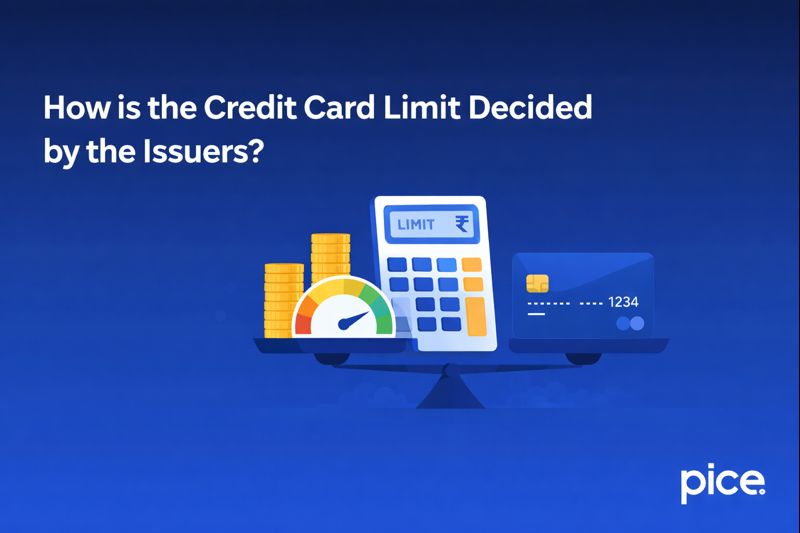
Your credit card limit (irrespective of issuers) is decided based on several factors, such as your income (monthly or annually), income stability, current credit score, repayment history and more. Let us explain each factor with examples so you can easily comprehend how issuers determine your credit limit.
- Source of Income
Card issuers check your income while determining your credit card limit. Typically, they follow a simple formula to calculate: Basic Credit Limit = Monthly Income × (2 to 3)
For example, your monthly income is ₹75,000. Your credit limit range will be between ₹1,50,000 and ₹2,25,000. Look at the following to get an overview:
| Monthly Income | Initial Credit Limit Range |
| ₹25,000 | ₹50,000 - ₹75,000 |
| ₹50,000 | ₹1,00,000 – ₹1,50,000 |
| ₹1,00,000 | ₹2,00,000 – ₹3,00,000 |
| ₹1,50,000 | ₹3,00,000 – ₹4,50,000 |
However, the range is not static and can vary based on other significant factors.
- Income Stability
Employment stability, whether you are a salaried or a self-employed individual, also plays a pivotal role when credit card providers evaluate your borrowing capacity.
Imagine two scenarios: Rahul earns ₹60,000 monthly, holding a good position in a government organisation for 5 years. He will receive a ₹1,80,000 limit at the initial stage when applying for a credit card.
On the other hand, Priya, who also earns the same, will only get a card with a limit of ₹1,20,000 as she is associated with a private organisation and has changed 3 jobs within 2 years.
- Existing Debts and EMIs
The credit card limit is also decided considering your current liabilities. Issuers minutely calculate the debt-to-income ratio (DTI) using a formula (the total debt you pay monthly ÷ your monthly salary) × 100 to ensure you are not financially overextended.
Look at the following examples to know how it works:
- Priya earns ₹50,000 per month and has no loans. She most likely will get an offer of a credit card with a ₹1,50,000 limit, as lenders find that her DTI is 0%.
- On the contrary, Gaurav earns the same but has a home loan worth ₹12,00,000. His DTI is 50% as ₹25,000 goes into the EMI, resulting in a lower ₹75,000 limit.
Most card issuers prefer candidates with EMIs remaining below 50-60% of their income.
- Credit Score and History
The higher the credit score, the more creditworthy you are, which means a higher credit limit. The factors that significantly impact the credit score include: credit payment history (35%), utilisation ratio (30%), length of credit history (15%), credit mix (10%) and new credit applications (10%).
In addition, how you utilise your credit considerably influences credit card limit calculation. Issuers prefer applicants who:
- Swipe their cards for regular expenses, but responsibly.
- Pay the outstanding in full rather than making partial or minimum amount payments.
- Avoid cash withdrawals and high-ticket purchases that can exceed your limit.
Total Credit vs. the Available Credit Limit
Your credit card's total limit is the maximum amount you can spend by swiping the card. The available credit limit is the amount that is left after your utilisation in a specific month. Calculating this amount is easy. Subtract your current outstanding balance from your total credit limit, and you get the available limit.
For instance, if your total credit limit is ₹1,50,000 and you have spent ₹50,000, your available credit is ₹1,00,000 for this month.
Must reads
How to Increase Credit Card Limit?
Once your limit is set by the credit card issuers, it does not mean it can not be changed in the future. You can increase your card limit in several ways, such as:
- Request for a Limit Increase
You can directly request your card issuer for a credit limit increase. To improve your chances, maintain an excellent credit score (750 to 900), keep your credit utilisation ratio low and update your financial information regularly (such as a salary hike, promotion or another source of income you generated in the last few months). All these factors strengthen your request for a higher limit.
- Wait for an Automatic Increase
Many banks periodically enhance your credit limit when they notice consistent usage and timely repayments. Although the process may take a while, it happens automatically; you do not need to take any additional steps. Simply continue using your card responsibly and you can enjoy a higher limit without even requesting it.
- Reduce Existing Burden of Debts
For instance, if you earn ₹1,00,000 monthly and pay ₹40,000 toward loans, your DTI is 40%. By clearing a ₹10,000 loan, it drops to 30%, showing lenders you can manage credit responsibly. A lower DTI signals financial stability, prompting issuers to offer a higher credit limit.
💡Pay your credit card bills in an easy and secure way with the PICE App.
What Happens if You Use Your Entire Credit Card Limit?
It is a very popular question among candidates regarding the credit card limit. The answer is that if you use your entire card limit, you will attract a hefty penalty (over-limit fee) set by the issuer, varying from issuer to issuer.
Other than that, your credit score drops drastically and it will make you ineligible for an increase in the credit limit in the near future. To remain in the good book, it is advisable to keep the credit utilisation ratio below or equal to 30%.
Conclusion
Knowing how credit card limit is decided is a wise step towards credit management in the near future. Consider the significant factors and end up getting a card with a higher credit limit. Banks and other card issuers periodically review your borrowing capacity by gauging your spending habits, credit score and payment patterns and adjust accordingly.
However, you can also ask for a credit limit enhancement if your income increases. For that, you need to submit proper evidence to the issuer, such as salary slips for the last 3 months or the last year's income tax return.
FAQs
How credit card limit is decided for first-time users?
It is mainly based on income, job stability, and limited or no credit history.
Does a higher salary always mean a higher credit limit?
No, how the credit card limit is decided also depends on debts, credit score, and repayment behaviour.
Can self-employed individuals get high credit limits?
Yes, if income is stable and credit history is strong, issuers decide limits favorably.
Does using the full credit limit affect future increases?
Yes, maxing out your limit can hurt your credit score and delay enhancements.
Can I request a limit increase manually?
Yes, and how credit card limit is decided then depends on updated income and credit health.
Read More About Credit Card






About the author

Key Takeaways Earn up to 10% cashback on dining and...
 0
0
0
Related Articles



×


Want an answer to all your B2B Payment Problems?
Pay your Vendors and Collect from customers with ease using Pice's Payment Solutions. Get:
-
 Instant Transfer
-
 Lowest Rates
-
 Credit on all transaction